Showing posts with label Locust Leaf Farm Tour. Show all posts

Tuesday, January 3, 2012

2011- A Locavore Year in Review by the Nomadic Chef

As 2012 begins, I would like to review some of the highlights of the Nomadic Chef  Locavore posts of 2011 the Year of the Rabbit


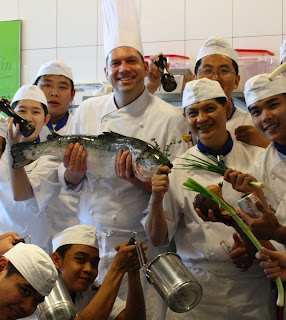
The year started off slow, but by mid February I was in Singapore teaching a Western Cuisine class At-Sunrice Global Chef Academy.  Because of that adventure this blog began.  While visiting China Town and all the Food Hockers I became re-energized with the passion of eating fresh, local foods,thus the idea of the Nomadic Chef Locavore blog began. 


During 2011 I made my own cheese from local Rhode Island farm milk.


I built two raised garden beds to supply some of my own fruits & vegetables over the summer.  I then went to the  19th Annual Rare and Unusual Plant Sale to buy heirloom vegetable plants to fill the beds.


I had the great pleasure of touring two local farms, first I went to Blackbird Farm in Smithfield, RI where they raise Black Angus Beef as well as Rhode Island Red Chickens.  The second farm I toured and have bough chickens, a half of a lamb, a quarter side of beef and my Thanksgiving Turkey from is Locust Leaf Farm in Foster, RI.  Both farms are small family run farms that serve different consumers but both are a model of sustainable local farming.  I also frequented many of the great Farmers Markets the Rhode Island has to offer.


Johnson & Wales University in Providence, RI hosted its first Food Day Celebration at the Harborside Campus where I made sure to take snap many pictures posterity. 


There were three very inspiring locavore focused books I read in 2011,

Title

A Year of Food Life

Barbara Kingsolver, with Steven L. Hopp and Camille Kingsolver


Tomatolandcover

All three of these books are very though provoking and show a side of our food industry that most Americans have no idea about, or even care about.  But they should!!!  I would recommend everyone to read these books, I will even let you borrow them if you are local to Rhode Island.

I had the pleasure of participating in three conferences this year, the 2011 CAFE Conference, Research Chef Association Conference and the National Produce Show and Conference. 


Finally I ended up the year celebrating Christmas in Montreal, and enjoying the local markets full of charcuterie and French cuisine.


That is a quick review of my Locavore 2011, looking forward to a local, fresh, sustainable, prosperous 2012.  Happy New Year !!!!!  Feel free to read the older posts to get a more in depth idea of what this blog is all about.

Until I blog again  Eat Well, Live Life and Be Safe


Saturday, December 24, 2011

A Montreal Christmas Day 2- Christmas Eve

la veille de Noël

Today is Christmas Eve and in the morning we focus on the Montreal's  Public Markets/Farmer's Markets to find food for our Christmas Eve and Christmas feasts.  We started at Jean-Talon Market where I purchased an array of fresh vegetables to cook and serve with my Locust Leaf Farm leg of lamb that I brought with me from home.  But if I wanted to I could have purchased any meat, produce, dairy, bread and dessert item imaginable while there.

While at the public market I also purchase a the traditional Christmas Eve or Christmas dinner tourtière or meat pie originating from Quebec, they has a few types, Pork, Pork with Beef and Pork with Duck.  The just pork was sold out, so I chose the pork and beef as I knew my mother would not eat the pork and duck.  What would a Christmas Eve feast in Canada – Réveillon – be without tourtière, the classic meat pie beloved of Quebeçois and French-Canadians everywhere?

Here are some photos I took a the market.


Until I Blog Again:  Eat Well, Live Life and Be Safe

Sunday, November 20, 2011

Brining My Thanksgiving Turkey (Cranberry, Apple & Sage)

Happy Thanksgiving:

I purchased a  11 1/2 # farm raised no hormones or antibiotics turkey for Thanksgiving from Locust Leaf Farm in Foster, Rhode Island. (want to learn more about where and how I got my turkey?  click here) The following blog post will detail how I brined the turkey.


First lest start by asking why brine a fresh farm raised turkey?  Well brining adds moisture and flavor to the turkey and helps to keep it from drying out. Not only will your turkey be moist and tender but you will also accent the natural flavor of the bird. Planning is the one the most important part of the brining process, brining to early could be disastrous, brining to late would be a waste of time. You will need to brine your turkey roughly one hour for every pound.  For my turkey I started brining my turkey 11 hours prior to the turkey making its way into the oven.

For the brine: (recipe a variation of Good Eats Roast Turkey)

  • 1 cup kosher salt
  • 1/2 cup light brown sugar
  • 1/2 gallon chicken stock
  • 1/2 gallon apple cider
  • 1 tablespoon black peppercorns
  • 1 bunch fresh sage
  • 2 bag of fresh cranberries
  • 1 gallon heavily iced water

Directions

Combine the chicken stock, salt, brown sugar, peppercorns, sage in a large stockpot over medium-high heat. Stir occasionally to dissolve solids and bring to a boil, add one bag of cranberries (they will pop like popcorn), boil for one minute.. Then remove the brine from the heat, cool to room temperature, and refrigerate.

Early on the day or the night before you'd like to eat:
Combine the brine, water and ice in the 5-gallon bucket. Place the thawed turkey (with innards removed) breast side down in brine. If necessary, weigh down the bird to ensure it is fully immersed, cover, and refrigerate or set in cool area for 8 to 16 hours, turning the bird once half way through brining.

Cooking
Preheat the oven to 500 degrees F. Remove the bird from brine and rinse inside and out with cold water. Discard the brine.
Stuff the turkey with the second bag of cranberries and truss the turkey.  Need help or don't know how to truss a turkey?  Click here  coat the skin liberally with canola oil.

Roast the turkey on lowest level of the oven at 500 degrees F for 30 minutes.

A 11 to 13 pound bird should require approximately 2  hours of roasting or until the thickest part of the leg reads 165 degrees on a meat thermometer.

Let the turkey rest, loosely covered with foil or a large mixing bowl for 15 minutes before carving.

Until I Blog Again:  Live Life, Eat Well and Be Safe

Sunday, November 13, 2011

My Thanksgiving Turkey- from Locust Leaf Farm- Happy Thanksigiving

Happy Thanksgiving, in this post I would like to give thanks to the many small farmers who give chefs, cooks and foodies the chance to buy all natural farm raised meats and produce throughout Rhode Island and throughout the United States.

If you have followed my blog you will recognize the name Locust Leaf Farm, so far I have purchased a 1/4 cow from them, a side of lamb as well as eggs and other miscellaneous items.  Check out my original Locust Leaf post here

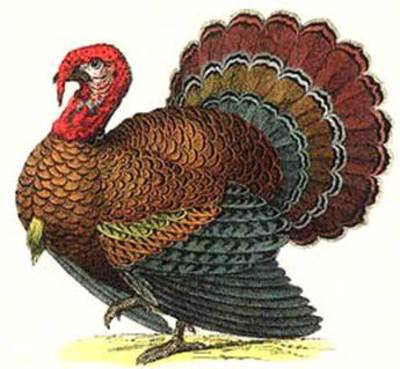
Today I purchased a Farm Raised Turkey for Thanksgiving from Locust Leaf Farm, the farm gets the birds in June when they are only a few weeks old and then raise them on the farm in very large open air coops.  While in the coops the turkeys are given unlimited all natural fresh food (including treats of vegetables and grasses) and water.  Thus the turkeys are able to walk, jog and play turkey games throughout the day. Unlike the mass produced turkey farm turkeys you buy in the supermarket (see below)


Locust Leaf Farm raised and sold 40 turkeys in 2010 and  this year they have already sold 50 birds before January 1st . Because of the consumer demand they decided to expand and raise 75 birds for this Thanksgiving.

Locust Leaf Farm processes their own birds right on the farm, and they also process for other local farmers.  They do this as a family, with the help of 2 other trusted individuals.  This year they are estimating that they will process between 400 and 500 birds the week leading up to the Sunday before Thanksgiving..

I purchased a 11.5# Turkey for $40.25 , the largest turkey they raised this year was a little bit over 28#.


The farm even raised a few heritage breed birds this year, the Blue Slate Tom Turkey. The heritage birds were hatched by the farmers daughters and  preschoolers.  A picture of the Blue Slate Turkey that was taken at the farm a is below:


This is unlike the mass produced turkeys you buy in the store: 
The Secrets Behind Mass Turkey Production
via the Business Pundit

Slate has an informative ditty about how turkey suppliers meet huge Thanksgiving demand, which amounts to roughly 46 million turkeys during a single week. Suppliers must plan a year ahead:
Market leader Butterball…has already begun the production cycle for next year’s holiday season. Eggs for breeder birds have been purchased from one of the world’s two major genetic suppliers, Hybrid and Nicholas. Those eggs will then be hatched and placed in turkey farms so that they can grow and become sexually mature during the winter. Come springtime, these birds will produce the eggs that are destined to become the turkeys we actually eat.
The eggs laid next spring will be incubated for 28 days and then, after they hatch, the resulting turkeys will spend about 10 to 18 weeks on a farm before they’re brought into the processing plant in late October and November. The birds are slaughtered, quickly chilled…then shipped out to retailers, usually all in the same day.

The article adds that turkeys need to be bred with human help:
The vast majority of turkeys sold in the United States…have been bred to produce as much white breast meat as possible, resulting in males so large and unwieldy that they can’t properly mount the females. Toms therefore have to be manually stimulated and “milked” for their semen, which is then inserted into a hen using a syringe.
And that, folks, explains how your roasted bird made it from farm to table. Not a pretty process!
Article printed from Business Pundit: http://www.businesspundit.com.

You choose what method you prefer, you already know mine, and for that I give thanks to all the small farmers
HAPPY THANKSGIVING

Until I blog again- Live Life, Eat Well and Be Safe...gobble gobble gobble

Friday, June 3, 2011

Locust Leaf Farm Tour- Foster RI

While surfing on the Farm Fresh RI website, searching for farms that sold local farm raised meet retail  I came across Locust Leaf Farm in Foster Rhode Island.

Specializing in Custom Slaughter
Fresh Artisan Beef, Lamb, & Poultry
Foster, Rhode Island


For more information, please contact Bill and Julia at 401-647-4385


Locust Leaf Farm is a small local farm specializing in Fresh beef, turkey, chicken, and Lamb. They do NOT use any antibiotics, hormones, etc. When you pull up to the farm, not only are you greeted by the dog but the sheep, cattle, pigeons and the chickens are all very close. When I pulled into the driveway the family was out planting vegetables under the supervision of their dog.

The unique part of their farm is that they have a clean, state of the art processing facility on the property. With this, they are able to cut and wrap the meat on the property, ensuring that their customers get the cuts they want, and that the meat is not handled by multiple people. They also have meat cutting services available to other farms.

Last week when I called Locust Leaf Farm to see what products were available. When Julia answered she asked me what I was interested in and why, and then I was asked to first the farm. Then after the visit, if I like what I observed I could be put on the waiting list and then we could discuss what items are available for sale.  I liked that idea, so I schedule for a tour. 

Locust Leaf Farm, is a small farm, with just enough animals to provide fresh meat for the family and for a small group of customers.  I love the idea of seeing the animals all in one location (a few cows were in friends fields off the farm) and knowing how they have been treated and when and where they were slaughtered.

The following are the details and photo's of my tour:

I arrived shortly after 1:30 pm, and as I mentioned above Julia and her two daughters where out planting vegetable plants in the front yard.  I was quickly greeted and given a tour of the picturesque farm.  First stop, the butcher shop.  Very small, but appropriately sized for the size of the farm and the amount of meat they butcher. 


The Butchery:


The Chickens for slaughter-
Although the don't know it, they will be killed tomorrow, and the meat ready for sale the next day.


The Next Generation
The next group of chickens to eat drink and cluck until they are time for slaughter.


The Hens  for Eggs:


The Cattle:
Oreo (in the first picture) is a friendly cow, she comes right up to greet you...


The New Addition:


The Sheep
Luckily for the farm each mother gave birth to two lambs.


After the tour, I was able to buy some ground beef and a beautiful sirloin steak and am now on their contact list.  Farms like Locust Leaf Farm, Blackbird Farm (see my blog a few posts ago) are great examples that farms can survive in today's economy, compete (albeit on a small scale) against large box stores.  And perhaps the most important part is that the product has been treated humanely, is superior in taste and quality and is clearly a better for the environment.

The adult chickens get slaughtered tomorrow, the turkeys right before Thanksgiving, the sheep in the fall.

For more information, please contact Bill and Julia at 401-647-4385

Until I blog again, Eat Well, Live Life and Be Safe