Friday, October 21, 2011

Food Day 2011

Mix one part farmers market, one part Rhode Island Locavores and Chef's, a large group of culinary students and a dash of folk music and you have Food Day!

On Friday October 21, 2011 the Johnson & Wales University Campus in Providence, Rhode Island celebrated their first ever Food Day at the Harborside Campus. The purpose of this food/farmer/culinary focused holiday is to bring together Americans from all walks of life—farmers, parents, teachers, and students; health professionals, community organizers, and local officials; chefs, school lunch providers, foodies and eaters of all stripes—to push for local, healthy, affordable food produced in a sustainable, humane way.  Food Day leaders, volunteers and supporters will work with people around the country to create thousands of events in homes, schools, churches, farmers markets, city halls, and state capitals http://foodday.org/about-food-day/

Actually Food Day is to be celebrated on October 24th each year and is backed by an impressive advisory board that includes chefs, farmers, anti-hunger advocates, physicians, authors, politicians as well as JWU's own Karl J. Guggenmos, the university dean of culinary education at Johnson & Wales.  Although the official Food Day celebration on on Monday October 24, 2011, JWU decided to celebrate a few days early due to the fact that there are typically no classes on Fridays, thus giving all of the students a chance to participate.

Chef William Idel, Department Chair for the JWU culinary bachelor degree program was the organizer of the event.  Chef Idel, was impressed with the turn out and thank full for the great New England autumnal weather.


Many thanks go out to the JWU chef's and student volunteers who participated in this great event as well as the the following vendors.
  • Agriculture in Westport
  • Allen Farms
  • BreadHitz- Chef Ciril Hitz
  • Confreda Farms
  • Farm Fresh RI
  • Fresh Point
  • Johnson & Wales Green Collaborative Garden
  • Metcalf-Franklin Farm
  • North Star Farm
  • Sid Wainer & Son
  • Southside Community Land Trust
  • The Local Catch

Menu Items Included the following:


Until I Blog Again: Eat Well, Live Life and Be Safe

HAPPY  FOOD DAY


Friday, September 9, 2011

Food Day- A Culinary Holiday

Last Earth Day, I proclaimed that Earth Day should become a culinary holiday. I got ahead of myself, because culinarians, foodies and locavores now really do have a food holiday, it called Food Day. and the first one will be on Monday October 24th in2011 and in years to come.  I hope all of my followers, locavores and culinarians will join me in making the first food day a great success.  Please log on to the Food Day website and join the cause.


via http://foodday.org/

Food Day seeks to bring together Americans from all walks of life—parents, teachers, and students; health professionals, community organizers, and local officials; chefs, school lunch providers, and eaters of all stripes—to push for healthy, affordable food produced in a sustainable, humane way. We will work with people around the country to create thousands of events in homes, schools, churches, farmers markets, city halls, and state capitals.

The 6 FOOD DAY PRINCIPLES
  1. Reduce diet-related disease by promoting safe, healthy foods
  2. Support sustainable farms & limit subsidies to big agribusiness
  3. Expand access to food and alleviate hunger
  4. Protect the environment & animals by reforming factory farms
  5. Promote health by curbing junk-food marketing to kids
  6. Support fair conditions for food and farm workers

Until I blog again, Eat Well, Live Live and Be Safefair conditions for food and farm workersions for food and farm workers

Friday, August 5, 2011

Making Farmhouse Cheddar

Let the Cheese Making Commence:
Although I have dabbled in making soft cheeses (such as mozzarella) in the various hotels and restaurants that I have worked in I have never really had the opportunity to make different types of cheeses, more specifically hard cheese. That's about to change.

So how do you make cheese you ask, well take a look below at this friendly diagram.


I purchased my cheese making supplies from the Cheese Queen , also know as Ricki Carrol who owns New England Cheesemaking Supply, Inc in South Deerfield, MA.  I learned about the Cheese Queen while reading Animal, Vegetable, Miracle A Year of Food Life by Barbara Kingsolver.

So here is what I bought and had shipped to my mailbox for a little over $40.00
Deluxe Basic Cheese Making Set Item #:G3 

This Deluxe cheese making set contains Ricki's Basic Cheese Making Kit, 1pound of Red Wax and a Natural Bristle Brush, everything you need to make a variety of delicious cheeses. (Farmhouse Cheddar, Colby, Monterey Jack, Cottage Cheese, Gouda, Parmesan and Feta)


CONTENTS: Basket Mold, Vegetable Rennet Tablets,  Mesophilic DS Starter, Thermophilic DS Starter, Mini Budget Thermometer, 1/2oz. Calcium Chloride , 1 yd Re-usable Cheesecloth, Recipe Booklet, Red Cheese Wax, Natural Bristle Brush 

The following are the details (and pictures) of my Farmhouse Cheddar .

To age my cheese I will be using an old wine cooler that I have in my basement.  The wine cooler works well because I can adjust the temperature to between 52-55 degrees, the ideal cheese ripening temperature.

Since I live in Rhode Island where raw milk sales are illegal I will be using pasteurized store bought milk.  I do however plan on purchasing raw milk in Massachusetts the next time I make cheese.
Take one gallon and 3.5 quarts of 1% milk, add 1 pint of heavy cream in a large pot, add one pack of Mesophilic DS Starter and place the pot into a hot water bath in the sink.
 Heat the milk to 90 degrees and let sit for 30 minutes, add 1/2 rennet table and let sit for an additional 30 minutes.
     
 Cut the curd and slowly bring the curd up to 100 degrees while gently stirring.
     
 Drain the curd for an hour.
     
 The curd becomes a ball.
     
 Press the curd with 10 pounds for an hour.
     
 Press the curd for 20 pounds for 2 days
     
 After the two days, take the curd out of the mold and air dry for 3-5 days.
     
 Coat the cheese with cheese wax.
     
    Place in the cooler to age for two months.  Check back around Halloween  to see how the cheese comes out, or maybe I will give Farmhouse Cheddar Treats to the Trick-or Treaters...
    Until I Blog Again: Eat Cheese, Live Life and Be Safe

Friday, July 22, 2011

Holy Quarter of a Cow- My Experience Buying a 1/4 Cow

I just purchased a Quarter Cow from Locust Leaf Farm in Foster, RI.   

If you follow my blog, most likely you have already read my blog posting entitled "Locust Leaf Farm Tour" if not please do so and learn more about this wonderful farm operated by the Boyce family.
A quarter cow from Locust Leaf Farm is actually a half of a cow, divided in half again.  This way the buyer gets cuts from every section of the cow.  See Below:


You may asked yourself why would anyone buy a 1/4 of a cow.  The following are my top reasons, David Letterman Style....

  • #10- It passes the time
  • #9- Beef it's whats for dinner
  • #8- So I don't have to ask myself "Where's the Beef?"
  • #7- I did it on a dare
  • #6- Lady Gaga needed it for her next dress
  • #5- Endless Sauerbraten
  • #4- It is part of being a "Locavore"
  • #3- Cheaper than going to the Farmers Market every week
  • #2- To support a local small farmer who raises animals humanely with no growth hormones or antibiotics
  • #1- It is sure damn tasty- pasture raised, great marbling, and ohhhh so good!!
All kidding aside the reasons I bought the 1/4 cow was to have pasture raised, local beef, beef that is not fed corn, that is not confined to a feed lot and is not given growth hormones to make it grow fat quick.

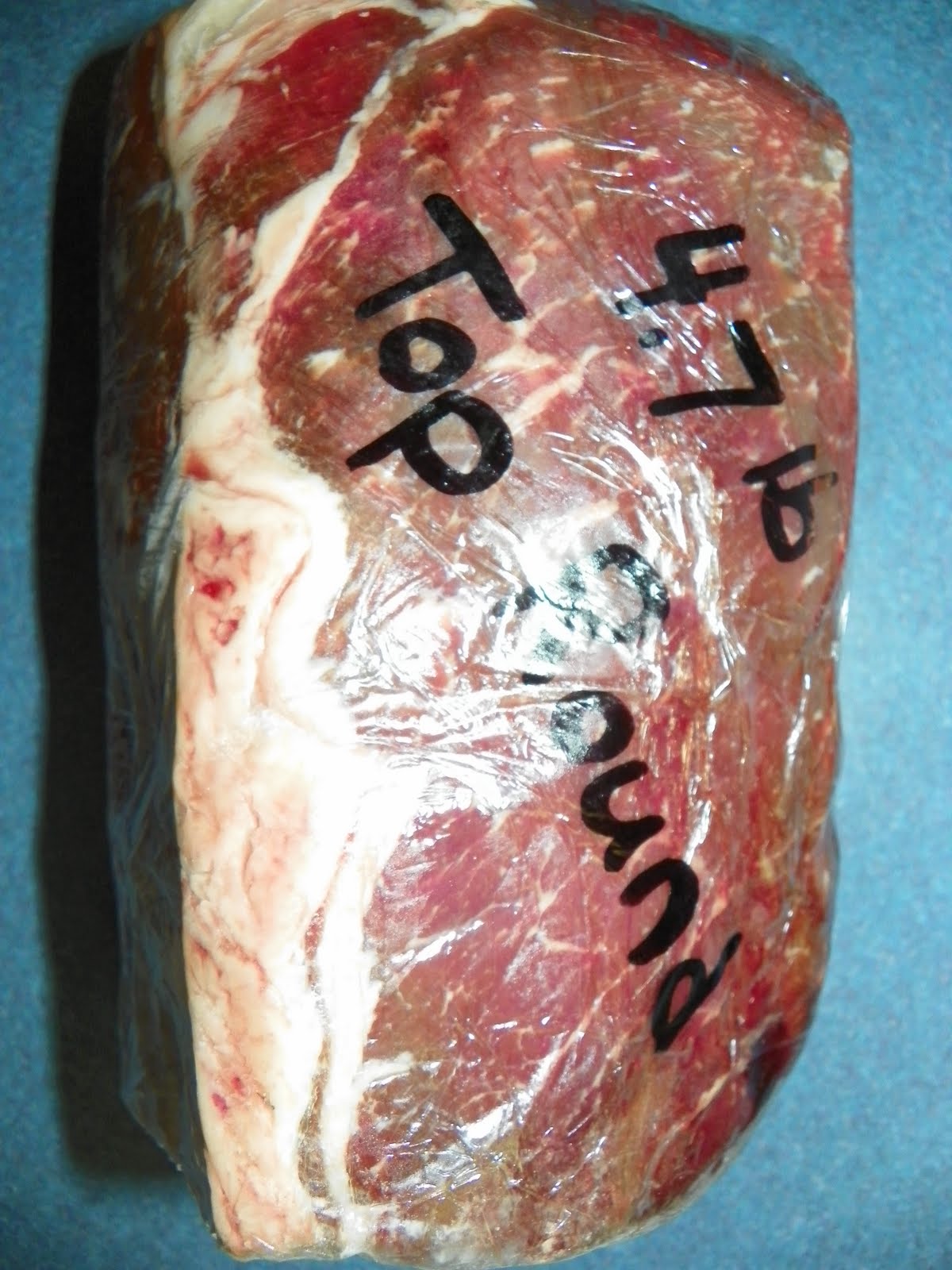
Here is what I got: Tenderloin Steaks, Sirloin Steaks, Ribeye Steaks, Porterhouse Steaks, Stew Meat, Beef Liver, Beef Bones, Beef Shanks, Beef Brisket, Chuck Roast. Short Ribs, T Bone Steak, Sirloin Tips, Top Round, Bottom Round, Ground Beef


How much does a quarter cow get you? I received roughly 150 pounds of product

How much did it cost? $4.10 per pound = $625 , well worth the cost if you asked me.

I also picked up 6 whole chickens that were slaughtered last week.  Yum
Until I blog again:  Eat Well, Live Life and Be Safe

Wednesday, July 20, 2011

Common Sense in Culinary Arts

The thought of this post has been with me for some time, even before I started blogging.  As a chef, I learn to do by touching, smelling, tasting, hearing and seeing.  I am just lucky to be part of a profession that utilizes all of the senses to teach the trade to aspiring apprentices.


As a educator, I quickly realized how the senses are just as important in teaching, many studies have shown that engaging students senses (using color, smell, lighting, music) to teach a subject increases memory and helps them recall information when put in a similar environment. Unfortunately most teachers only appeal to two senses seeing and hearing. Those two sense are usually engaged by the teachers use of PowerPoint, where the screen is overloaded with text, no pictures as the teacher reads exactly from the slide... The teacher and the student are slowly lulled into a state of boredom where no learning takes place.

The best way to reach all learners is to use varying techniques and multiple senses.

It is my belief that in order to be a good teacher, educator, trainer:

In an educational culinary kitchen setting

Touch: and feel your product, learn the difference between ripened and unripened fruit, the ability to touch a steak and know the doneness. Anytime I personally encounter a new product, I make sure I touch it, smell it, taste it..

Smell: your product, know the difference between the smell of a product that is fresh, a product that has been around for some time, and is bad.
Taste:, although you would think I would not have to elaborate on this point, taste is one of the hardest things to teach a cook.  The absence of salt and pepper is one of the biggest pet peeves of any chef.  If you don't taste the food you prepare, you shouldn't be serving it.  Plain and simple.
Hearing: other than the fact that most people believe the know how to listen to instruction, but actually don't, the act of hearing in a kitchen helps any young cook develop "kitchen sense" the ability to walk into any kitchen and just by listening be able to pick up on the kitchen vibe, if the kitchen is disorganized, stressed out, or a well running machine and to quickly pick up on the mood of the chef.

Seeing: seeing is the sense we take for granted, just because you looking at something does not mean you are actually seeing it in respect to what is actually going on as your brain often times takes is not always paying attention to every detail. (see the counting game part I & II below)

In a non culinary kitchen setting, educators have to go above and beyond often times to incorporate senses into their lessons.  The old teachers adage of "I do, We do, You do" is often preached but rarely practiced.   

Touch: when ever you can have the student touch an example of what is being discussed, or at least get them up and moving around every now and then. When you touch something the mind is able to associate it with facts.

Smell: different scents have been shown to enhance learning, the scents of lemon and lime elevates the mood while mint awakens, the scent of popcorn builds anticipation and vanilla sooths. Smells can take us back to previous events and experiences, both good and bad.

Taste:  unfortunately today our children have many food allergies, using this sense is often times more difficult than in years past.  In reality a majority of what we believe is taste is actually related to the smells we pick up as we are eating something we only taste salty, sweet, sour, bitter and unami  .  Often times when you taste something it brings back memories of a time, a place, an event where you encountered the same smell before.


Hearing: Music is an element that may also be heard throughout the day. The role of music in learning is well known. Music "enriches the human intellect and spirit. It can provide solace or joy; it can entertain or educate. And music is a universal language, which helps bind together the human community (Campbell and Brewer, 1998).

Sight: Brain research suggests that color and lighting may influence learning. Birren (1977) reported that warm colors and brilliant lighting increased muscular tension, respiration rate, pulse, blood pressure, and brain activity. Insufficient lighting causes visual fatigue. Distracting color combinations can lead to task confusion and slow reaction. Quality lighting and appropriate colors improve visual processing and reduce stress (Birren, 1972).

Pink: soothes; promotes affability and affection.
Yellow: expands the space, cheers your spirit; increases energy.
Black: disciplines, authorizes, strengthens what's around it; encourages independence.
White: purifies, energizes, unifies; in combination, makes all other colors stronger.
Orange: cheers, commands; stimulates appetites and conversation.
Red: empowers, stimulates, dramatizes; symbolizes passion.
Green: balances, normalizes, refreshes; encourages emotional growth.
Purple: comforts, spiritualizes; creates mystery and draws out intuition.
Blue: relaxes, refreshes, cools; produces tranquil feelings and peaceful moods.

I have used several books and articles in this blog and from them have developed a strong believe in utilizing multiple senses to help students learn and achieve.

Brain Rules by John Median is often my first source I go to to find out the if, why, what of how the brain works.

Food Safety Education Using Music Parodies
  • SOME GENERAL CONCLUSIONS
    • Music can be used to improve food safety education
    • •Musical styles and messages need to be tailored for individual audiences
    • •Individual instructors may have significant influence in determining how well food safety music aids learning
    • •Music needs to be available in formats that are easy for instructors to use (DVD, CD, PowerPoint, Flash, VCR, etc.)

  • SOME GENERAL CONCLUSIONS
    • The intervention group experienced more statistically significant gains in attitudes and appeared to have a better pattern of gains in cooking related
      knowledge and behaviors. Given limited resources, demonstration cooking classes could reach larger audiences in varied settings, but the impact would likely be weaker than that of cooking classes.


COMING TO OUR SENSES: INCORPORATING BRAIN RESEARCH FINDINGS INTO CLASSROOM INSTRUCTION.


  • SOME GENERAL CONCLUSIONS
    • Scientists and educators alike have produced volumes of evidence and studies that demonstrate the significant impact that the environment has on learning. But why are we not putting into practice brain-based environmental strategies when we have evidence that they work? The key to a quality-learning-productive environment is a sensory-rich, brain-based classroom using techniques that include visual, color, music and sound, wide-spectrum lighting and even aromas. As long as the student's physical needs are met, and the student feels safe and secure in an environment, sensory enrichment really has no limits.
      We can reduce stress through the use of color by incorporating blues and greens into our classroom walls and floor coverings; using yellow on a bulletin board in the area of the classroom where teachers conference with children to set future goals could produce good benefits; simple changes including changing out light bulbs and using natural lighting has demonstrated many benefits; teaching new information through song and music maximizes the use of teaching time; and incorporating aromas with new learning has been shown to increase recall.
      Enriching student learning through using sensory strategies in a brain-based environment is one of the easiest and most rewarding ways for an instructor to begin to improve the learning environment and academic outcomes for all children! Teachers can no longer ignore the significance the sensory environment and to fail to implement the fore mentioned, well-researched sensory and brain based teaching strategies. We educators must "come to our own senses" and implement the senses through brain-based environments and activities if we are to maximize learning opportunities for children!
Until I blog again: Use your Senses,  Eat Well, Live Life and Be Safe